How to Read Your Tyre Sidewall Markings
A clear, numbered guide to every marking on your tyre — size, load index, speed rating, age code and more.
Home / Blog / How to Read Your Tyre Sidewall Markings
Look at the side of your tyre and you will see numbers, letters, arrows, and small symbols going all the way around it. At first, tyre sidewall markings can look confusing. But you do not need to understand every tiny code to use them properly.
The diagram below gives you a numbered map of the common markings — use it as a quick reference. This guide goes one step further, explaining what those markings actually help you do: from choosing the correct replacement tyre to checking tyre age, pressure, fitting direction, and special features.
Quick Guide to the Numbered Markings
Use the numbered picture alongside the list to find each marking. You do not need to memorise all 22 — the important part is knowing which ones matter for the job you are trying to do.
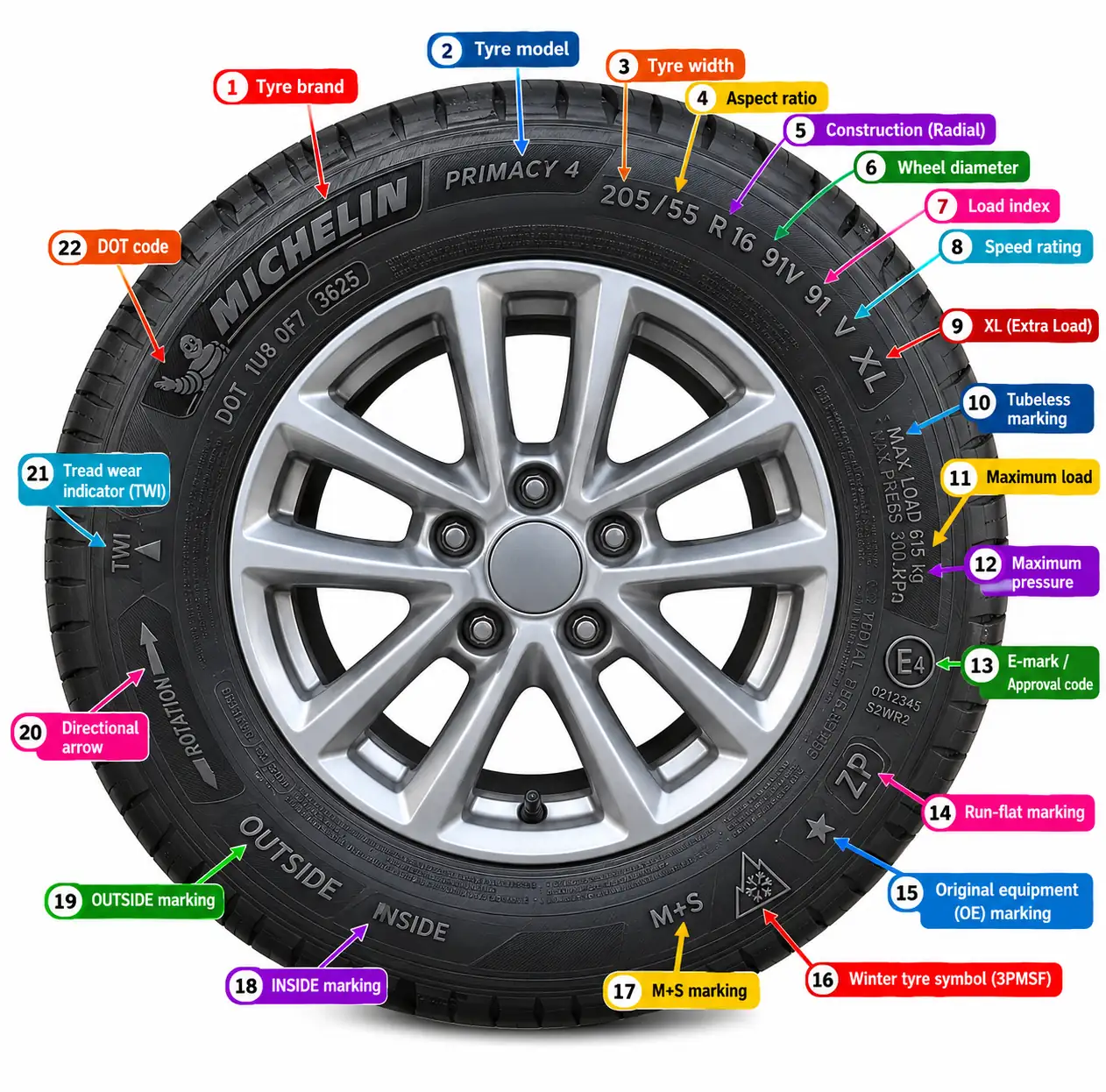
Tyre brand — Who made the tyre
Tyre model — The tyre range or pattern
Tyre width — For example, 205 mm
Aspect ratio — Sidewall height vs. width
R — Radial construction
Wheel size — For example, 16 inches
Load index — Load the tyre can carry
Speed rating — The tyre's speed capability
XL — Extra Load tyre
Tubeless — No separate inner tube
Maximum load — Maximum tyre load allowed
Maximum pressure — Tyre limit, not daily pressure
E-mark — An approval marking
Run-flat marking — Tyre with run-flat construction
OE marking — Approved for a vehicle manufacturer
3PMSF — Tested snow-performance symbol
M+S — Mud and Snow marking
Inside — Side that faces the car
Outside — Side that faces away from the car
Rotation arrow — Correct direction to fit
TWI — Tread wear indicator location
DOT / date code — Manufacturing date and age
Start With the Most Important Code: 205/55 R16 91V
If you are buying a replacement tyre, start here. This full code is much more useful than simply saying "I need a 16-inch tyre" — many different tyres can fit 16-inch wheels.
| 205 | Tyre width in mm |
| 55 | Sidewall height as a percentage of width |
| R | Radial construction |
| 16 | Wheel diameter in inches |
| 91 | Load index |
| V | Speed rating |
What Information Should You Give a Tyre Fitter?
If you need a replacement tyre, take a clear photo of the sidewall or write down the full code — for example, 205/55 R16 91V XL. Also tell the fitter if you can see XL, run-flat markings, an OE marking, Inside / Outside, or a rotation arrow. This gives much more useful information than the wheel size alone.
For mobile replacement, Rapid Mobile Tyres offers mobile tyre fitting across Bristol and the South West.
Can Two Tyres Have the Same Size but Still Be Different?
Yes — and this is one of the most important things many basic tyre guides do not explain clearly. Two tyres can both say 205/55 R16 but still have different:
- Load indexes
- Speed ratings
- XL ratings
- Run-flat construction
- OE approvals
- Seasonal ratings (M+S / 3PMSF)
For example, 205/55 R16 91V and 205/55 R16 94W XL are not exactly the same specification. That is why you should read the whole tyre code, not only the first three numbers — especially on higher-performance cars, which are often more sensitive to the correct load and speed rating.

Load Index, Speed Rating, and Why XL Doesn't Mean Extra Large
Load Index
In 205/55 R16 91V, the number 91 is the load index. It does not mean 91 kg — it matches a value in a standard load table. For example, load index 91 corresponds to 615 kg per tyre under the relevant conditions. Do not fit a tyre with a load capacity below what your vehicle requires, and do not automatically change specification without checking.
Speed Rating
The letter after the load index — Vin this example — is the speed rating. It does not mean you should drive at the maximum speed connected with that rating. It tells you the tyre's tested speed capability, and your replacement tyre should meet the requirements for your vehicle.
XL — Extra Load, Not Extra Large
XL means Extra Load. It does not mean the tyre is physically bigger — an XL tyre is designed to carry a higher load than a standard version of the same size. So 205/55 R16 91V and 205/55 R16 94V XL may look very similar but have different load capabilities.
Checking Tyre Age: DOT Codes and E-Marks
Look for a four-digit date code, often after the letters DOT. For example, 3625 means the 36th week of 2025. Tyre age matters because a tyre can still have tread but show signs of ageing — cracking, hard rubber, splits, or unusual surface changes. Do not judge a tyre only by tread depth; its age and physical condition matter too.
You may also see an E inside a circle followed by numbers — an approval marking, with the number identifying the country that granted it. For most drivers, there is no need to decode the full approval number; the main point is that it is an approval marking rather than part of the tyre size.
Maximum Pressure Is Not Your Normal Tyre Pressure
This is one of the most important safety points on the whole sidewall. A tyre may show MAX PRESS followed by a value — that is a tyre limit, not normally the pressure you should use every day.
Look for the vehicle manufacturer's recommended pressure instead — usually found inside the driver's door, on the door pillar, inside the fuel flap, or in the owner's handbook. The correct pressure may also change depending on vehicle load, so do not simply inflate to the maximum number printed on the sidewall.
Tread Wear, Fitting Direction, and Inside / Outside
TWI — Tread Wear Indicator
Find the TWI mark on the sidewall, then look across the tread at the same position — you should see a raised wear bar inside the main groove, which helps you see how far the tyre has worn. For cars and light vans in the UK, the legal minimum tread depth is generally 1.6 mm across the central three-quarters of the tyre and around its full circumference.
Inside and Outside
Some tyres are asymmetric and marked INSIDE and OUTSIDE, meaning the two sides of the tread do different jobs. OUTSIDE should face away from the vehicle; INSIDE should face toward it. A tyre can be the correct size and still be fitted incorrectly if these markings are ignored.
Rotation Arrow
Directional tyres have an arrow showing the correct rotation direction — the tread pattern is designed to move that way, especially for moving water through the tread. If you see a rotation arrow, check it after any tyre fitting.
M+S, 3PMSF, Run-Flat, and OE Markings
M+S means Mud and Snow and is commonly seen on all-season and winter-type tyres. The 3PMSF mountain-and-snowflake symbol shows the tyre has passed a standardised snow-performance test, so it gives stronger evidence of tested snow performance than M+S alone.
Run-flat tyres may be marked RFT, ROF, SSR, or ZP depending on the manufacturer. A run-flat tyre and a standard tyre can share the same basic size but are not identical — if your car is set up for run-flat tyres, check the manufacturer's recommendations before changing tyre type.
Some tyres also carry an OE (Original Equipment) code developed or approved for a particular vehicle manufacturer — for example AO (Audi), MO (Mercedes-Benz), a star (BMW), or N0/N1/N2 (Porsche). Not every car needs an OE-marked tyre, but the marking can matter on certain vehicles, so check its meaning before replacing a tyre that carries one.
A Better Way to Read a Tyre: Follow This Order
Instead of trying to read every small symbol at once, work through the sidewall in this order:
- 1
Find the tyre size — 205/55 R16
- 2
Find load and speed rating — 91V
- 3
Look for special construction — XL, run-flat, OE markings
- 4
Check fitting instructions — Rotation, Inside, Outside
- 5
Check tyre age — Four-digit date code
- 6
Check the physical tyre — Cracks, bulges, cuts, uneven wear
The Most Common Sidewall Reading Mistakes
Understanding these mistakes is often more useful than memorising every code:
- Reading only the wheel size
- Thinking 55 means 55 mm
- Thinking 91 means 91 kg
- Treating the speed rating as a recommended driving speed
- Thinking XL means extra large
- Using the maximum pressure as everyday pressure
- Ignoring Inside and Outside markings
- Ignoring the rotation arrow
- Assuming M+S and 3PMSF mean the same thing
- Forgetting to check run-flat or OE markings
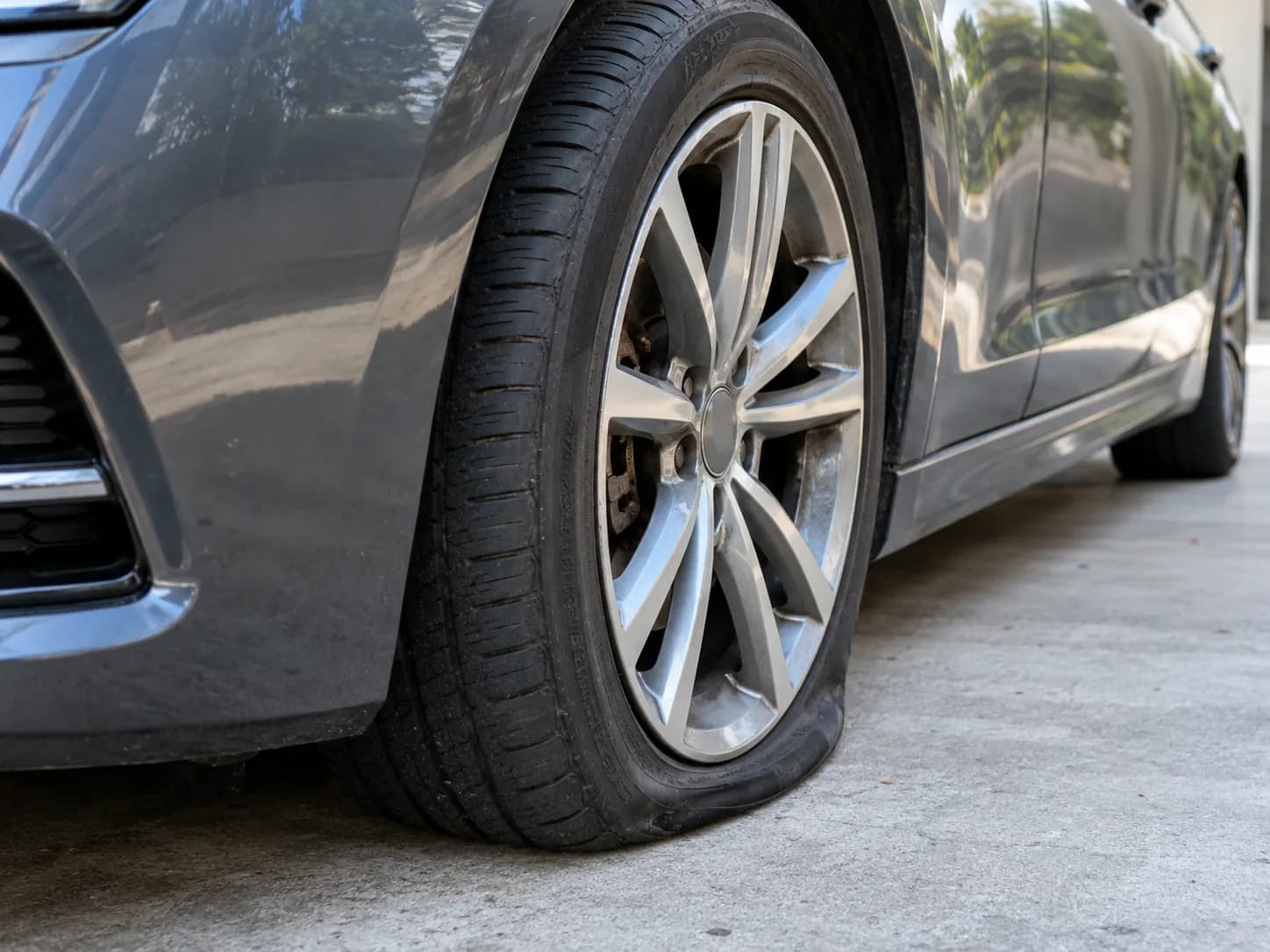
A tyre that has gone flat or suffered sudden damage often shows exactly why these checks matter — a correct replacement needs the full code, not just a rough size. If you are stuck on the road with a tyre like this, emergency mobile tyre fitting can come to you.
Quick Replacement Tyre Checklist
Before ordering a new tyre, check and note down:
- Full size — e.g. 205/55 R16
- Load index — e.g. 91
- Speed rating — e.g. V
- XL, if required
- Run-flat marking, if fitted
- OE code, if relevant
- Inside / Outside, if asymmetric
- Rotation arrow, if directional
- Manufacturing date, for age
Then check the actual tyre condition for low tread, cracks, cuts, bulges, uneven wear, or pressure loss. If anything looks wrong, have it checked — do not assume a tyre is safe just because it fits the wheel. Rapid Mobile Tyres can also carry out a tyre replacement at home once you know the correct specification.
Frequently Asked Questions
What is the most important information on a tyre sidewall?
For buying a replacement, start with the full tyre size, load index, and speed rating. Then check for XL, run-flat, or OE markings if they apply.
What does 205/55 R16 91V mean?
205 is the tyre width in mm, 55 is the aspect ratio, R means radial construction, 16 is the wheel diameter in inches, 91 is the load index, and V is the speed rating.
Can two tyres with the same size still be different?
Yes. They can have different load indexes, speed ratings, construction, seasonal ratings, and special features such as XL or run-flat.
Is the maximum pressure printed on the tyre my correct everyday pressure?
Usually not. Use the pressure recommended by your vehicle manufacturer, found on the door pillar, fuel flap, or in the handbook.
How do I check when my tyre was made?
Look for the four-digit DOT date code. For example, 3625 means week 36 of 2025.
What does XL mean on a tyre?
XL means Extra Load. It does not mean the tyre is physically bigger.
What is the difference between M+S and 3PMSF?
M+S means Mud and Snow and is a general marking. 3PMSF (the mountain and snowflake symbol) shows the tyre has passed a standardised snow-performance test.
What if I cannot understand one of the markings?
Take a clear photo of the sidewall and ask a tyre professional. It is always better to check than to guess.
Final Takeaway
You do not need to memorise every tyre sidewall marking. Start with the ones that help you make a real decision: what size is the tyre, what load and speed rating does it need, is it XL, run-flat, directional, asymmetric or OE-specific, how old is it, and is it still in safe physical condition?
Once you can answer those questions, the sidewall becomes genuinely useful instead of just looking like a ring of random numbers — and the numbered diagram above can work as your quick reference whenever you need to identify a less common marking.
Not Sure Which Tyre You Need?
Send us a photo of your sidewall and we'll confirm the correct replacement, then fit it at your home, workplace or the roadside — 24/7 across Bristol and the surrounding areas.